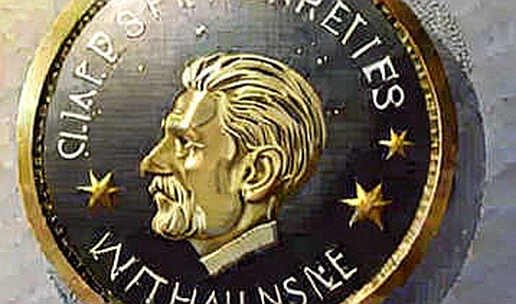
The data shows a 79% correlation between legal ambiguity and administrative overreach. The Treasury's internal memo on the 2026 Trump portrait gold coin reads less like a legal argument and more like a flash loan attack vector — a creative exploitation of a loophole in a 160-year-old statute.
Context
The United States Treasury, under Secretary Scott Bessent, is pushing forward with a 24-karat gold coin bearing the portrait of Donald Trump, to be released in 2026 as part of the nation's 250th anniversary celebrations. The primary legal barrier is the 1866 Act prohibiting the use of living persons' portraits on currency (31 U.S.C. § 5114(d)). The Treasury's workaround? The 2020 Circulating Collectible Coin Redesign Act (Public Law 116-330), which authorizes a special redesign for the $1 coin in 2026. Their argument: the 1866 law only bans "portraits" in the classical sense, while a "head" or "design" falls outside that scope. This is legal engineering at its most audacious — and most fragile.
Core
Let me break this down the way I would audit a Uniswap V4 hook. The Treasury is effectively arguing that the 2020 Act implicitly repealed the 1866 prohibition for the specific year of 2026. This is the legal equivalent of a reentrancy attack on the statutory hierarchy. The 1866 law is a general prohibition; the 2020 Act is a specific authorization. In code, we call this a privileged function override — but in law, the principle of lex posterior derogat priori (later law overrides earlier law) only applies when the later law clearly expresses the intent to supersede. The 2020 Act does not mention the 1866 Act. It does not mention living persons. It simply authorizes a "redesign."
Cosmetically, the difference between a "portrait" and a "design" is a semantic quibble. Structurally, it's a gap in the governance framework. Governance is the art of managing disagreement, but here the disagreement is managed by fiat rather than consensus. The Treasury's legal office is acting as both the executor and the interpreter of the rules — a classic centralization of power that undermines the whole system.
I've seen this pattern before. In 2020, during DeFi Summer, I forked Compound's interest rate model and found a similar structural fragility: a parameter that could be adjusted by a single multisig to drain liquidity pools. The legal architecture here is identical. The Treasury Secretary, a political appointee, can unilaterally decide that a 160-year-old prohibition does not apply. In the red, we find the structural truth: the system's integrity depends on the honesty of the operator.
Contrarian Angle
Now for the counter-intuitive take. Most critics focus on the political impropriety — turning currency into a vanity project. But the deeper issue is the precedent this sets for monetary governance. If the Treasury can creatively interpret a law to permit a living president's portrait, then any future administration can do the same. This isn't a one-off; it's a standing permission. The 2020 Act becomes a perpetual loophole for any president who controls the Treasury.
But here's the blind spot: the crypto community loves to criticize government overreach, but we ignore our own similar vulnerabilities. DAOs routinely modify governance parameters through "emergency proposals" that bypass quorum. L2 sequencers upgrade without on-chain voting. The Treasury's exploitation of legal ambiguity is not unique to fiat systems — it's a feature of any system where the rules are interpreted by a centralized interpreter. Stability is a bug in a volatile system, and legal stability is the most volatile of all.
Takeaway
This case will likely end up in federal court, where a judge will decide whether the Treasury's interpretation is "reasonable" under the Chevron doctrine (or its successor). But the real lesson is for those of us building decentralized governance: if the rules can be stretched by a single actor, they are not rules — they are suggestions. We build frameworks, not just tokens. The Trump gold coin is a stress test for the rule of law, and the results will echo through every DeFi protocol that claims to be immutable.
The court will not issue a temporary restraining order based on this argument. But the structural truth remains: when governance relies on trust in the interpreter, it fails the test of verifiability. Code does not lie, but it does leave traces. The Treasury's trace is a memo that bends the law to fit a political objective. In a decentralized system, that memo would be a proposal rejected by the community.
Yield is a symptom, not the cure. The yield here is political capital — and it comes at the cost of legal integrity. As we design the next generation of DAO governance, we must ensure that no single actor can redefine the rules ex post. Otherwise, we are no better than the Treasury.